Hardly Dark Ages

Short 07 · 1208–1235 · 3 min read

Why Most People Passed Trial by Ordeal

Hungary, the early 1200s. Your trial: carry a red-hot iron. And you'd probably pass.

The Short is coming soon on YouTube.📚 Books on this

A trial you would probably pass

A judicial ordeal was a physical test, run with church ritual, that was believed to show God's judgement in a case people could not otherwise decide. The popular picture is simple: the ordeal was a death sentence, and everyone got burned. The surviving records tell a different story. In Hungary in the early 1200s, an accused person might have to carry a red-hot iron, and most of those who actually did so were declared innocent.
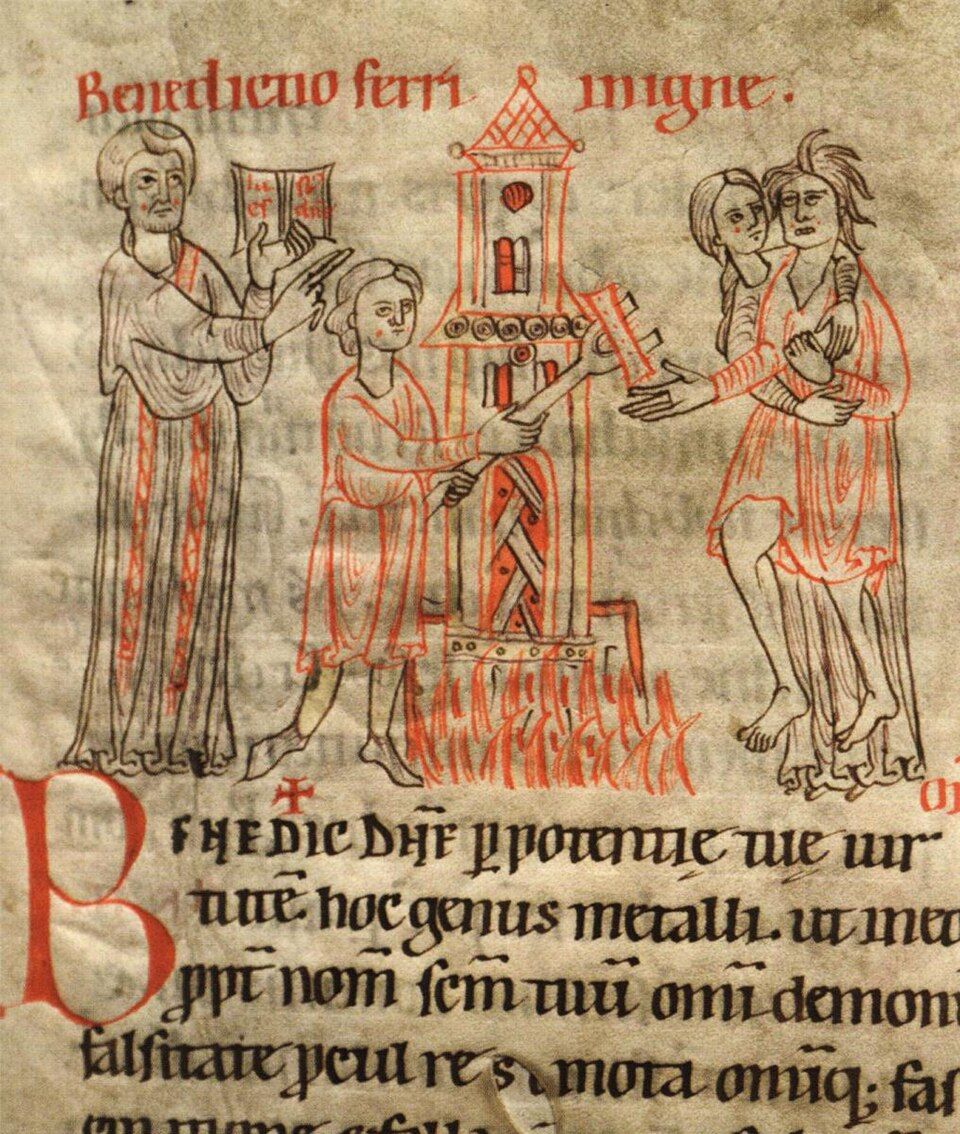
Medieval manuscript drawing of the ordeal of the hot iron
The ordeal of the hot iron, from the Rituale of Lambach Abbey (Stiftsbibliothek Lambach, Cml LXXIII), late 12th century.Unknown artist, Lambach Rituale, public domain, via Wikimedia Commons

How the hot-iron ordeal worked

The surviving liturgical formulas describe a fixed ritual. The accused fasted and prayed for three days. The priest blessed the iron and heated it in a fire inside the church, said mass and gave the accused communion. The accused then carried the iron a short, measured distance: nine feet in the formula translated by E. F. Henderson, and nine feet divided into three sections in King Æthelstan's 10th-century English law. The hand was bound and covered under seal for three days. When the seal was opened, a hand judged "clean" meant innocence and one judged "foul" meant guilt.

A Hungarian study of the Várad material describes the same core ritual there: the bishop blessed and sprinkled the iron, and the hand was sealed and opened before witnesses three days later. The Hungarian sources give three or nine paces, so we simply say "a few steps".
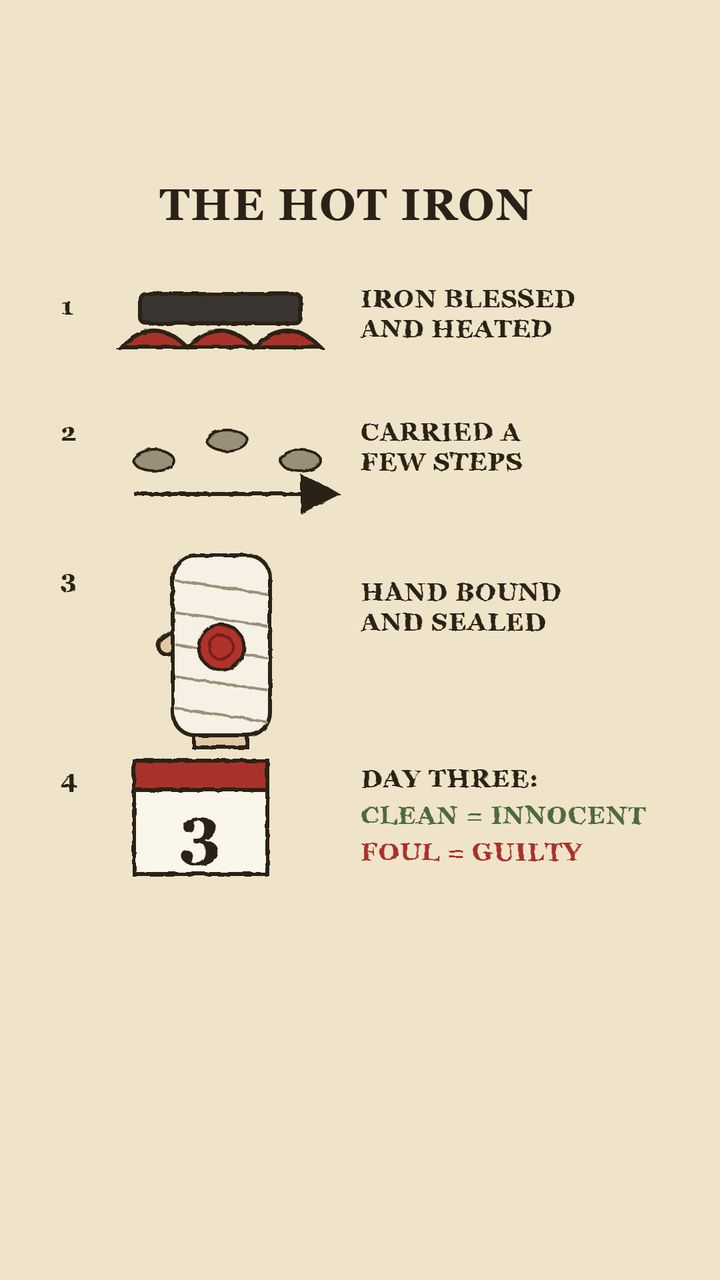
Diagram of the hot-iron ordeal: the hand is sealed, checked after three days, and judged clean or foul
The hot iron: the hand was sealed for three days, then judged clean (innocent) or foul (guilty).Diagram: Hardly Dark Ages (simplified)

Hot iron was one of three forms. In the hot-water ordeal, the accused took a stone or ring out of a cauldron of boiling water, and the hand was judged in the same way. In the cold-water ordeal, the accused was bound and lowered into blessed water: sinking meant innocence and floating meant guilt.
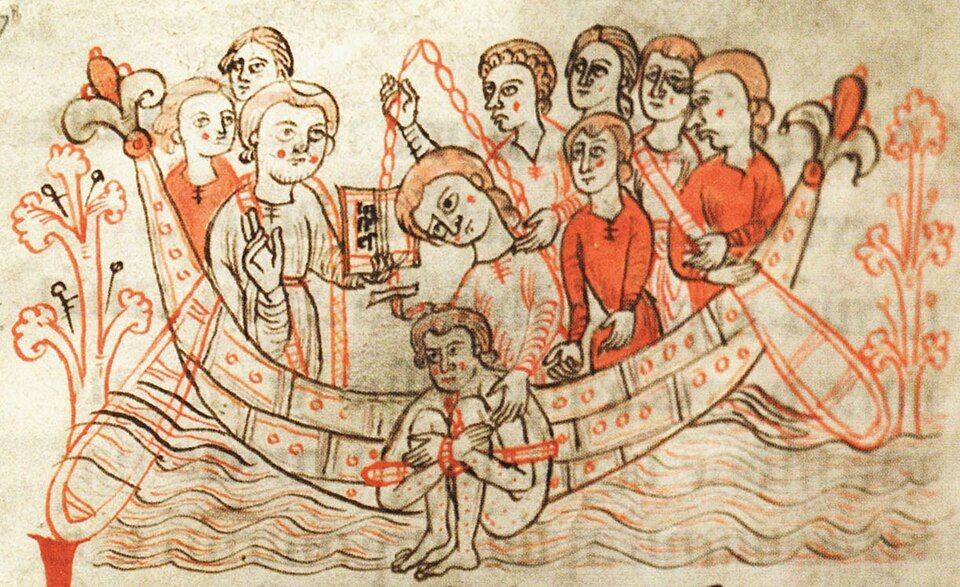
Medieval manuscript drawing of the ordeal of cold water
The ordeal of cold water, from the same Lambach Rituale, late 12th century.Unknown artist, Lambach Rituale, public domain, via Wikimedia Commons

The register of Várad

The best-known record is the Regestrum Varadinense, kept by the cathedral chapter of Várad in Hungary (today Oradea, Romania). It records hundreds of cases decided by the hot iron before the chapter between 1208 and 1235, under King Andrew II. It survives through a printed edition of 1550, and scholars count its entries differently: depending on the author, totals of about 345 to 389 appear. So there is no single agreed total.

What we can cite is one economist's count. Peter Leeson, following earlier work by Zajtay and van Caenegem, counts 308 cases with recorded outcomes. In 100 of them the ordeal never reached a verdict: 75 were settled and in 25 the accuser withdrew. Of the remaining 208 people who carried the iron, 78 failed and 130 were cleared: nearly two in three. Leeson calls this figure conservative. A much smaller body of evidence from English plea rolls of 1194 to 1219 points the same way: of 19 people with recorded outcomes, as reported by Leeson, 17 passed. Both samples are small and cover a short span of time.
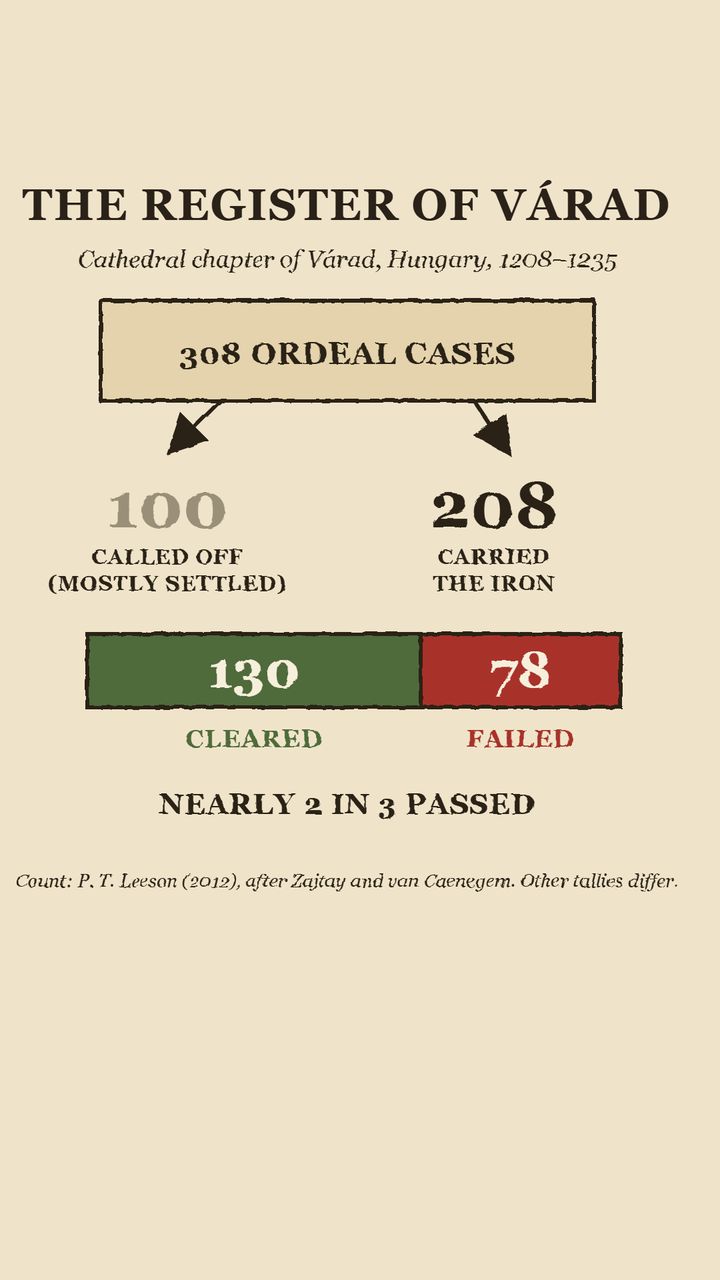
Diagram of the Várad register: 130 of 208 people who carried the iron were cleared
The register of Várad by Leeson's count: 130 of 208 cleared, 78 not.Diagram: Hardly Dark Ages (simplified)
Trial by Fire and WaterRobert Bartlett's book on the medieval ordeal, one of the sources for this storyAffiliate linkAmazon →

Leeson's argument, and why it is debated

Leeson puts the puzzle bluntly: unless most ordeal priests did not understand how to heat iron, something else was going on. His answer is a model from law and economics. Because people believed in the judgement of God, guilty defendants expected to fail and avoided the ordeal by confessing or settling. Innocent ones expected to pass and went ahead. The priest, seeing who was willing, could then make sure they passed: by letting the iron cool during a drawn-out final prayer, by sprinkling the hand with holy water, by keeping witnesses at a distance, or through his own discretion in judging a hand "clean".

This is an argument, not settled fact. It fits the pass rates, but no source records a priest saying he did this. Historians such as Robert Bartlett stress the ordeal as a last resort for cases that could not be decided any other way, and explain its decline mainly through clerical criticism and changing theology. Ian Pilarczyk emphasises how subjective the judgement of the wound was. The high pass rates in the surviving records are not disputed. What we do not claim is that priests did cheat, that ordeals were accurate, or any pass rate for Europe as a whole.
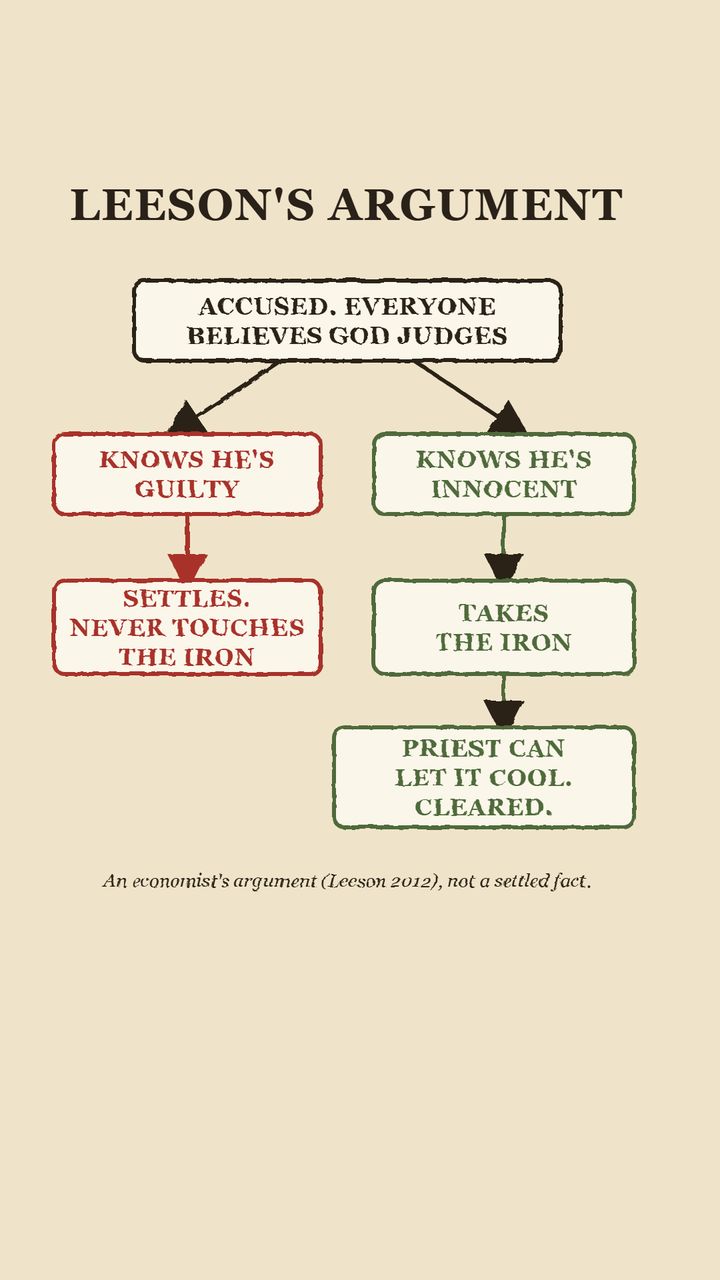
Diagram of Leeson's argument: the accused who knows he is guilty settles, the one who knows he is innocent carries the iron, the priest can let it cool, and he is cleared
Leeson's sorting argument (2012), simplified. An argument, not a settled fact.Diagram: Hardly Dark Ages (simplified)

The end of the ordeal

Theological objections had been building since the 12th century, notably that ordeals "tempted God". In 1215 the Fourth Lateran Council, under Pope Innocent III, forbade clergy to perform any blessing or rite of consecration over the ordeals of hot or cold water or hot iron (canon 18). Without the priest, the ordeal lost its religious basis, and secular courts dropped it within a generation: Denmark in 1216, England in 1219, Scotland in 1230 and Italy in 1231. Hungary did not stop at once, since the Várad register runs to 1235, but across Europe the ordeal soon faded.
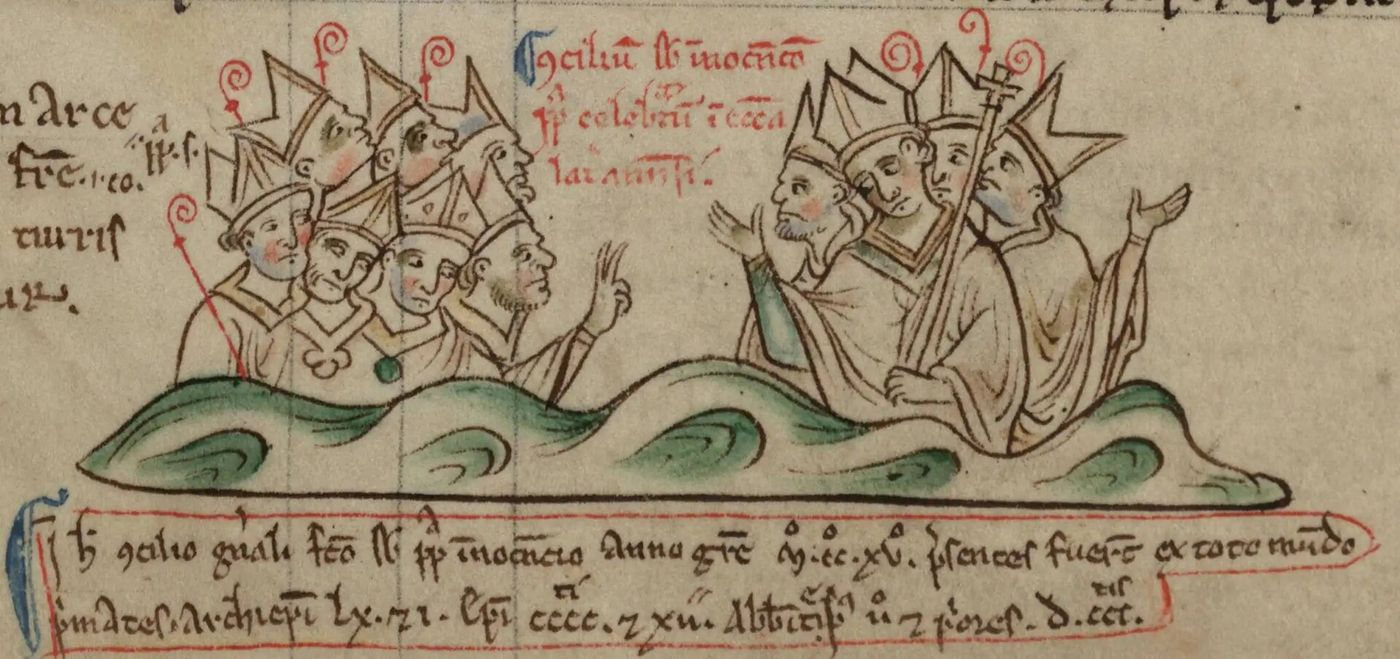
Medieval manuscript drawing of the Fourth Lateran Council
The Fourth Lateran Council of 1215, as drawn by Matthew Paris in his Chronica Majora (13th century).Matthew Paris, Chronica Majora, public domain, via Wikimedia Commons
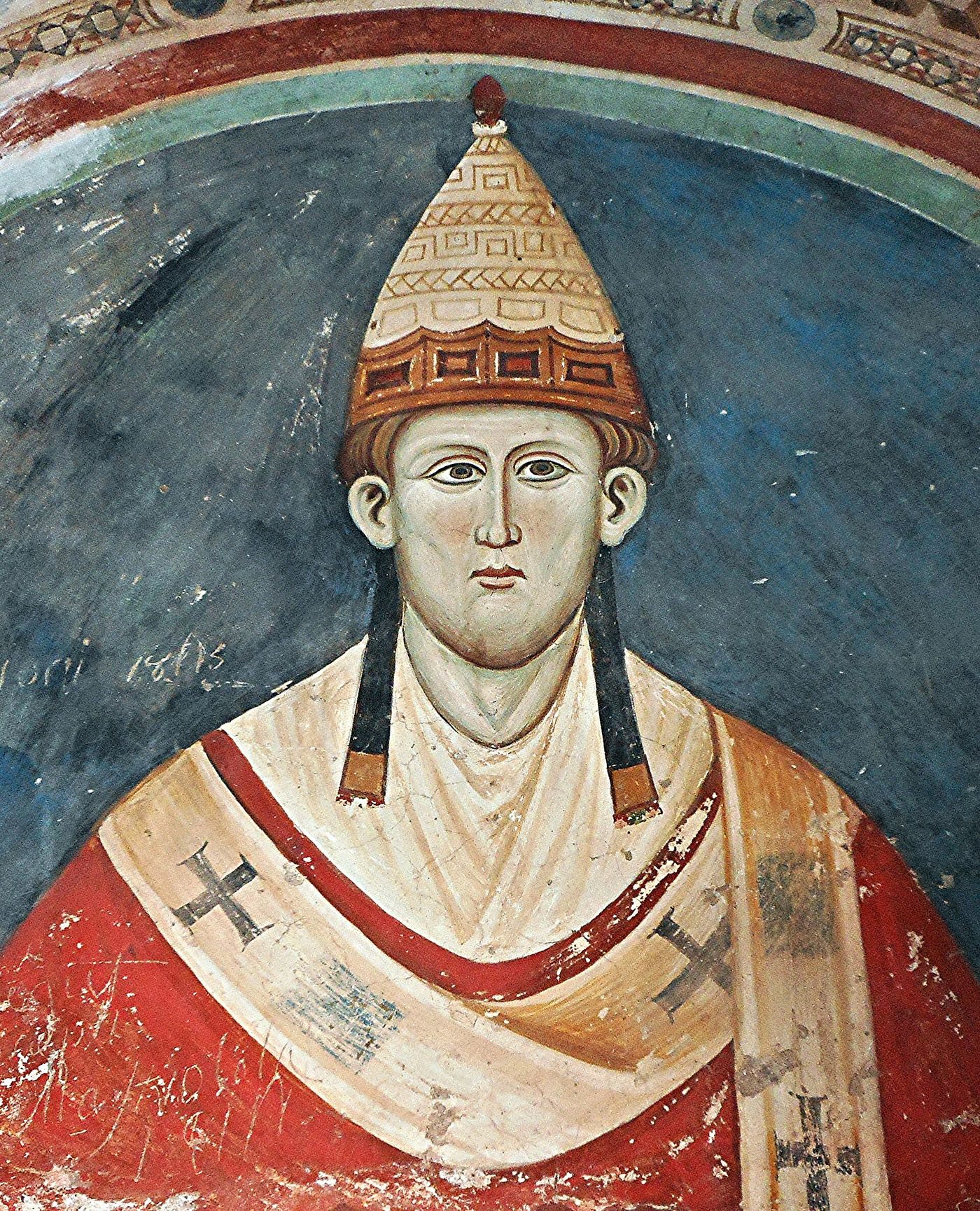
Fresco portrait of Pope Innocent III
Pope Innocent III, who presided over the council. Fresco, mid-13th century, Sacro Speco, Subiaco.Fresco at the Sacro Speco, Subiaco, photo Carlo Raso, public domain, via Wikimedia Commons

📚 Want more?

As an Amazon Associate I earn from qualifying purchases.

Fact check 8 claims
Ordeal by red-hot iron in Hungary (Várad/Nagyvárad, today Oradea) in the early 13th century.Lysý 2024 (Forum Historiae 18/1, pp. 54 f.: register 1208–1235, very frequent hot-iron ordeal before the chapter of Várad); Leeson 2012 (register 1208–1235, basilica of Nagyvárad); Wikipedia "Regestrum Varadinense" (Curta 2006, Engel 2001)
The hand was bound and sealed and checked after three days: clean meant innocent.Henderson 1910 (Fordham Medieval Sourcebook, ordeal formulas: "covered under seal for three days"); Æthelstan's law (Howland 1901, quoted in Leeson 2012: "on the third day … clean or foul"); for Várad: Mediaevalia Transilvanica 1999 (seal, opened after three days)
A register of hundreds of such trials, kept by the cathedral chapter.Lysý 2024; Wikipedia/Curta 2006 ("hundreds of trials by ordeal", canons of the cathedral chapter)
"By one economist's count": 208 hot-iron ordeals carried out, 130 passed (62.5%), 78 failed.Leeson 2012, pp. 23–24 of the working-paper version (after Zajtay 1954, van Caenegem 1991). Presented as the count of one researcher; other counts of the cases differ (Lysý 2024: totals of 345–389 entries depending on the author).
"Couldn't work a fire" (joke).Paraphrase of Leeson's own punchline ("Unless nearly two thirds of ordeal-officiating priests didn't understand how to heat iron …")
Leeson's thesis: belief in iudicium Dei means the guilty settle or withdraw, only the (supposedly) innocent carry the iron, and the priest can manipulate the outcome (e.g. let the iron cool).Leeson 2012 (abstract, pp. 10–12); explicitly marked in the script as "his argument, and it's debated"
In 1215 the Fourth Lateran Council forbade clergy to take part (blessing/consecration) in ordeals of water and hot iron.Canon 18 (IntraText/Schroeder translation; Howland 1901 via Leeson); Baldwin 1961 (Speculum 36)
Ordeals disappeared quickly afterwards (Denmark 1216, England 1219, Scotland 1230, Italy 1231 …).Leeson 2012 after van Caenegem 1991; Bartlett 1986 (standard work on the decline)

Deliberately left out (evidence too thin): The exact year "1210" (the register runs 1208–1235, so it is imprecise); the figure "62.5%" as a hard fact (only "nearly two in three", "by one count"); the cold-water ordeal and the gender split in England (Kerr/Forsyth/Plyley 1992: men sink more easily), too complex for a Short but covered in the research dossier; the claim "priests cheated" as a fact; details of punishments and injuries (no violence); "nine steps" (an English norm; for Várad three or nine steps are recorded).

Sources 5
  1. Peter T. Leeson, "Ordeals", Journal of Law and Economics 55 (2012): 691–714
    https://www.peterleeson.com/ordeals.pdf
  2. Robert Bartlett, Trial by Fire and Water: The Medieval Judicial Ordeal (Oxford: Clarendon Press, 1986) · on Amazon (affiliate)
  3. Miroslav Lysý, "On the Social Structure of the Kingdom of Hungary According to the Records of the Regestrum Varadinense", Forum Historiae 18/1 (2024): 54–63
    https://doi.org/10.31577/forhist.2024.18.1.4
  4. Fourth Lateran Council (1215), canon 18
    https://www.intratext.com/IXT/ENG0431/_PI.HTM
  5. Ordeal formulas, tr. E. F. Henderson (1910), Internet Medieval Sourcebook
    https://sourcebooks.fordham.edu/source/ordeals1.asp